Thursday, October 25, 2012

The Leprechaun Trail


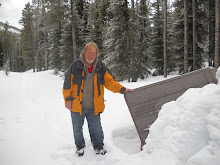
Oct. 13, 2012, I am in the interior of British Columbia staying in a ski hut at a place called Grizzly Den with my 2 older brothers. The day before yesterday we drove the Hungry Creek forestry road to the trail head and then hiked the 6.5 km into the hut. Yesterday was a snow day but by today the snow had stopped falling and much of the snow on the ground was already melting.
From the ski hut there is a day hike I have wanted to do on past visits to this place and today would be my chance to check out the trail. The trail is called the Leprechaun Trail. We started our hike at about 8:30 AM by walking back down the Grizzly Den trail to the Leprechaun trail junction.
Just by a wet meadow on the Grizzly Den trail a Rough Legged hawk silently swooped by and perched in a near by evergreen tree. As the three of us were observing the hawk a Merlin swooped in, dove at the Rough Legged hawk and drove it from its perch. As the larger Rough Legged Hawk retreated the smaller and much more maneuverable Merlin gave chase and they soon disappeared from view down the slope and across the meadow. In moments both birds reappeared from the direction they had gone, the Merlin still tenaciously pursuing the larger, less maneuverable Rough Legged. They swooped back past us and disappeared up the trail into the woods. As we proceeded on our way down the trail we speculated about what would provoke an attack on the larger by a smaller bird but we were not able to come to any solid conclusions. The best we could come up with was the Merlin was defending its territory.
 Several hundred metres down the trail we flushed a grouse off the trail and into a tree. We know there are three species of grouse in this area the Ruff grouse, Blue grouse and the Spruce grouse. I am reasonably sure this was a Blue Grouse. 
The Leprechaun trail is a steady hike up through evergreen woods. Much of yesterday' s snow was gone as there was no snow below about 5000 feet. As we hiked up the trail and we got back into some snow. Hiking in fresh snow facilitates the chance to observe what has and is happening in the woods and who or what resides there. As we moved along the trail we observed tracks of squirrel, marten, grouse and weasel. I noticed a burrow with tracks in and out. Maybe a Martin. Is this where it lives or was it just checking it out as part of it's hunt for food?
The Leprechaun ridge and the peak were windy but afforded us a grand view. The descent of the peak is steep and rugged but it isn't far down to Pat's Pass. We had some lunch in the shelter of trees then hiked up to Pat's Peak and another great view.
By mid afternoon we were back at the hut with good memories of a very satisfying hike.

The total hike was 7.21 km over about 5 hours.
Total ascent 2055 feet.
Maximum elevation 6169 feet.

 For more information about where the Grizzly Den and Raven Lake trails are and how to get there go to: http://www.trailpeak.com/trail-Raven-Lake-near-Prince-George-BC-2741

Monday, October 1, 2012

Rattlers and Rivers


On September 21, 2012 I drove to Writing On Stone Provincial Park to camp out with my Grandson. That evening we attended a park program about the night sky. During the program the audience received the requisite cautions about potential encounters with the Prairie Rattle Snake. This is the time of year when rattlers are on the move back to their hibernaculum. Also because of the cooler evenings snakes are attracted to warm areas, like pavement or rocks, in the morning so they can warm themselves up. As it turns out the Parks Person doing the presentation was proven absolutely right the following day. 

On September 22, 2012, while my grandson was reading his book, I went for a bicycle ride.I started out at about 9:30 AM I rode from our campsite up to the Park view point. I parked my bicycle at the trail to the view point and walked the short way up to the view point. What a great time of year it was to visit the park and see river valley in fall colors. I lingered there awhile and as I proceeded back along the gravel path I saw a very small rattle snake just in front of me. This snake would have been hatched this summer so it was rather small but I am told even small Rattlers have venom and should be treated with respect. When I first spied the snake it was relaxed and basking in the warm morning sun but as I rummaged through my pack and fiddled with my camera I clearly disturbed it and it coiled. I only tarried there long enough to snap a few photos and then I carefully stepped around the snake, watching closely for any others that might be near by, and left it to further enjoy basking in the sun.


No trip to Writing On Stone is complete unless you scramble around in the Hoodoos some, so that afternoon Levi and I spend about 3 hours exploring the Hoodoos. Levi even tried to catch a bush. For some humor in the hoodoos check out this link:

 http://www.youtube.com/watch?v=5ggzgDx28ZI&feature=share

Before leaving I tied my canoe on top of my van so I could paddle across the Milk River. I wanted to be sure I could take a walk on the south side of the river. Once I was at the park I discovered there was barely enough water in the river to float a canoe. On September 23, 2012, I waded across the river and then put on my hiking boots and did a 3.84 km walk in the back-country hiking area. I started around 8 AM and I followed a Track File, I had loaded on my GPS, of a hike I did in May 2007.  I observed a few Mule Deer in the river and as I walked a small canyon I observed a Rock Wren. This back-country hiking area is a quiet and little used part of the park, a great lace to reflect and take in more of the park's fall grandeur. I returned to our campsite at around 9:30 AM.

Fall colors in the Milk River Valley, from the south side looking north.


 My total distance recorded for the Writing On Stone camp out is 11.6 km, by bicycle and walking.


Friday, September 14, 2012

You Know You Are Having a Good Summer When....

You know you are having a good summer when you spend a lot of time being active and but not much time at the key board making Blog entries. The disadvantage of this is that now I have a long list of activities and experiences and a short time to get them all down. As I reflect back on my summer here are some of the highlights.

According to my notes I hiked the Bears Hump in Waterton National Park on June 29. I did it with my daughter's family, and my grandson. I was surprised with how strident my twin 5 year old granddaughters were at hiking up the trail. I look forward to many more hikes with them.
If you like small furry 4 legged creatures who are friendly then go to the top of Bear's Hump and ply the golden-mantled ground squirrel's friendship with nuts. Oh but I better add that feeding the wild animals in a national park is frowned upon.

Then on June 30, I was paddling my canoe with a friend on Islet Lake in the Cooking Lake Recreational Area. My I do get around.

Clearly a highlight of my summer was paddling the west arm of Myrtle Lake, BC with my brother and his grandson from July 2 to July 7. I now consider myself experienced as a kayak tripper.
On July 4, the three of us hiked up Central Mountain. The Central Mountain trail is rough at best but offers a great view of the Kostal Cone, a volcanic cone that erupted about 3000 years ago. We hiked until we encountered snow and that was as high as we wanted to go.

My notes from July 5, 2012 read:
Paddled the kayak past Leo island and then along, and into, every bay on the south shore of the lake. I came to a sign that says Hellset (a couple of days later I asked the park guy aboutthis sign. He said there used to be a trail to Hellset Lake but it is no longermaintained). Hellset is the last name of the guy who once had a cabin on thisbay.
An Osprey flew rightover me.
There was thunderin the south then it showered so I decided to return to camp. Left Hellset at 11:50 AM and got back to camp at 12:44PM. Less than 1 hour becauseof the threat of lightning and then near Leo Island a steady rain started.
On a rock south of Leo Island I observed a Barrows Goldeneye and a Common Merganser sitting on the same rock completely unconcerned with me as I silently glided by. Clearly scenes like this are why paddling is such a pleasure for me.


Wednesday, July 25, 2012

Crash Sites and Forest Fires

June 9, 2012, hike in the York Creek area, near Coleman, Alberta, to the 1946 crash site by Mount Ptolemy and Ironstone Lookout, solo:
 "On January 19, 1946, a Royal Canadian Air Force DC-3 (Dakota) left Comox, British Columbia on a flight to Greenwood, Nova Scotia. It never arrived and its crew of seven were reported missing. It took five days for the Crowsnest Pass Forest Rangers to snowshoe to the crash site because of bad weather. They were guided by the smoke of the burning plane. There were no survivors, the rescue team brought the bodies out on toboggans. The men who lost their lives were: Flying Officer Robert Huycke Watt, Flying Officer James Leonard Norris, Flight Lieutenant William Joesph Woods, Flight Lieutenant William James Sealy, Sergeant Vernon Rupert Ducklow, Leading Aircraftsman Daniel Levy and Leading Aircraftsman Richard Brockwell Lowe."
http://www.waymarking.com/waymarks/WM114_Dakota_Plane_Crash_1946

The aircraft apparently struck Mount Ptolemy and crashed near the headwaters of North York creek. I had been told about this crash site a couple of decades ago and I have intended to hike there ever since. Reading a description of the hike in Joey Ambrosi's Southern Rockies Trail Guide was the motivation I needed to finally attempt the hike.
I parked my vehicle along the forestry road on the north side of the bridge that crosses York Creek. I started my hike from there at just a little after 6 AM. There is some signage and with Ambrosi's trail description I was able to find the route. The hike is mostly on forestry roads and 4X4 and All Terrain Vehicle (ATV) trails. At about 1700 M long stretches of the trail still had snow. The snow was packed and solid enough to walk on so it did not hinder me much. At about 9 AM at 1900 M elevation I broke out of the trees to find the Cirque, where the crash site is, completely snow covered. I had intended to visit the crash site and then explore the alpine meadows and the ridge above it but I have no experience hiking in snow and the evidence of avalanche damage in the area discouraged me from venturing further. Once I left the shelter of the trees I found myself exposed to a stiff wind which was driving a light snow fall through the evergreens. I turned back down the trail and at about 9:15 AM, back in the trees and sheltered from the wind, I took a break.

Since I had planned to spend the day exploring the alpine meadows and possibly climbing the ridge behind the crash site I now had the time to take a more leisurely back and time to take a few photographs. While hiking up the trail I had noticed some bear scat but it appeared to be weeks old so I had little concern about encountering a bear. Also just before the place where the trail branches off to the Ironstone Lookout trail I heard, then came upon, 2 guys on trail bikes. The wideness of the trail and the ruckus that the ATVs and Trail Bikes made had me relaxed about encountering bears or any wildlife during my hike.
As I was hiking back I remembered the Trail Guide described a second hike up to the Ironstone Lookout on the Willoughby Ridge. I decided to at least hike to the start of that trail and determine where it is at. Once I arrived at the trail to the Ironstone Ridge I used my GPS Map to conclude that the summit was less than a kilometer away. It was not noon yet and I reckoned that I could hike up to the ridge in less than an hour and take a break for lunch when I got there. 
Over 2 km, because of some long switchbacks, and an hour and a half later and I was on the ridge.  At about 1900 M elevation I was encountering a lot of snow on the trail. The weather was still unsettled but the day was warming up and now the snow was softening and making it not as easy to walk on. In spite of feeling tired by this time, and knowing that I now faced at least a 6 km hike back to my vehicle, this was still an awesome hike. The Trail Guide describes the area like this, "Ironstone Lookout, perched on the crest of Willoughby Ridge, presents the determined hikers with a sweeping 360 degree panorama of the Crowsnest region and a dramatic overlook onto the extensive burn of the Lost Creek Fire". The Lost Creek Fire happened in July 2003 and burned about 22,000 hectares.
Once on the ridge there are two directions I could have gone. To the left was a communications tower about a kilometer away and to the right was a forestry Lookout. As I got to the ridge I was on a complete snow cover again and to walk to the Forestry Lookout I would be walking in deep drifted snow. There were no obvious tracks on the trail indicating to me that I had been the first to venture that far. I was also cognizant that I had already hiked about 17 km and it would still be a 6 km hike back to my vehicle. I decided to hike a little way up the ridge until I was at 2000 M elevation and take a much needed break. The sweeping view of the Crowsnest region made every step well worth the effort.


The access to the Ironstone Lookout is a 4 wheel drive road but it has a gate so there was no ATV traffic on that trail when I walked it. I found some fresh bear scat along the trail and one possible bear print. There were also numerous ungulate foot prints on the trail. The most striking part of the whole trail were the wild flowers. The Glacier Lily and Calypso Orchids were in bloom everywhere. 

As I walked the road up to the ridge I found this written in permanent marker on an old painted plank,
“In times of loneliness, who did you turn to? It was the fire. When your world came crashing down around your shoulders with hardship and pain, who stilled your grief? It was the sun. When the stern face of storms plagued you, who was there to give you shelter? It was the spruce and fir with their backs for cover and their scents of comfort. When trauma and confusion stole your spirit and spilled Hope to the ground, who woke in your dawn  ....?(this part is weathered away)?.... joy to your heart? It was the singing birds, the funny squirrels, the jumping fish, and the majestic caribou. When authorities controlled your life and were displeased, who returned solace and comfort? It was the eternal hymn from beautiful mountains and silent woods.” "Stan Walchuk Jr. Cordillera"
Given the time and place I was in when I read this I was profoundly moved by it, to say the least. I later Googled Stan Walchuk and found out that he traveled, by himself with two horses, from Alberta to Alaska through the Rocky Mountains. Cordillera is the title of the book he wrote about that journey. In a small way then I feel akin to him as I often am a lone hiker on a small journey of my own.

About 9 hours and about 24 km after I started out that morning I was back at my vehicle.

Thursday, June 14, 2012

Boats and Bears


May 27, 2012, canoe Touchwood Lake with my brother-in-law.
I believe this was the first time I had my old gruman canoe in the water this year and this is my first camp out of the year as well. It was might good to get out for a paddle. 
At about 9:45 AM we launched from the Touchwood Lake boat launch.
            Because the breezes were light, the sky was clear, the weather conditions appeared stable, and the lake was calm we set our course from the boat launch directly across the bay for the point of land jutting out from the west shore. Once we reached the point we held to the shore line on a southerly course. About halfway along the point we heard and then saw an Osprey. The Osprey appears to have a nest in a high tree at this place. We proceeded along the shoreline for as long as we could. There a good ‘fair weather’ campsite on the southern end of the point. From the southern tip of the point we picked the closest shoreline on the east shore and paddled directly for it. By this time a light wind had picked up and it produced low swells, which our loaded canoe easily navigated.
           The east shoreline tracks almost due south so we were able to hug the shore line all the way to the Seibert Lake Trail Head. Along this shore Tony spotted two Whitetailed deer. We also noticed surveyor’s ribbon in 2 places but we couldn’t determine what, if anything, they were marking. We arrived at the trail head at about 12:30 PM. The landing at the Seibert Lake Trail Head has limited space for boats and there is a half metre berm to lift the canoe over in order to beach it. This required that we unload the canoe with it still in the water so wear your rubber boots or be prepared to get your feet wet.
Distance = 12.6 Km.
Time = 2 hours 45 min. moving and 11 min stopped.

After lunch and a rest we did an afternoon walk to explore the trail over to Seibert Lake at about 300 M down the trail is a Trapper’s Cabin. The trail is maintained and seems to be used mostly by ATV quads. The trail would accommodate a canoe or kayak cart quite well which presents a possibility of portaging a boat to Seibert Lake and doing an extended trip. Seibert Lake has a long sandy beach. We walked north along the beach to where a rivulet flows into the lake. As we walked back to the trail we observed a Whitetailed Deer. The deer was quite a way south on the beach when I first saw it, but as we crouched and watched it moved closer to us. It was very twitchy and would graze and then move a bit further toward us. Eventually it bounded off into the woods. We then walked directly back to Touchwood Lake.
Total distance = 6.5 Km.
Total time = 1 hour 46 min. moving and 30 min stopped.

After supper we paddled the canoe along the south end of the lake to the out flow of Touchwood Lake.  We were only able to paddle down the out flow for about 100 metres before we came to a beaver dam. We saw a couple of beavers.
Distance = 2.6 Km.
Time = 47 min.

May 28, 2012, just as we were about to depart from our camp site we were doing one last walk through when my brother in law noticed a Black Bear on the trail. I held the dog while it barked and growled but the bear did not back off. Then Tony we moved toward the boat. As we moved away the bear advanced. The bear went to where we had kept our food and did our cooking. Then it moved to the site of the campfire and next it went over to the tent area. I prefer encounters with bears where the bears run away.
We left the campsite to the bear at about 9 AM. The lake was perfectly calm so we paddled directly across the south end of the lake to the west shore. We held to the west shore as we paddled north until the large point of land came into view. Then we set our course directly for the point. While we were canoeing the west shore we saw the osprey fly by. I also noted the location for the trail to Dabbs Lake. We stopped at the campsite on the point at about 11 AM. There is a small beach at this campsite which makes it an easy place to land a boat.  The site has a table, a bear cache and a biffy. Once we were around the point we held to the shore until the boat launch came into view and then we set our course directly for the boat launch. A light wind had picked up. The wind was mostly at our back so it helped us along. It produced a modest swell on the lake but it was easily navigated by our canoe. We made the boat launch area by about noon.

Distance = 14 Km.
Time = 3 hours moving, and 20 min stopped.
 The total distance traveled for this trip was 36.4 Km.

Saturday, May 19, 2012

Drywood Creek, wind, water, earth.


May 10, 2012, hike Drywood Creek, solo.

On March 25, 2012 I set out to hike Drywood Creek but I was reluctant to continue because of snow on the road.
This is hike #29 in Ambrosi’s Southern Rockies Trail Guide.
On this day I returned to Pincher Creek and even though I drove there, that morning, through a snow storm I still wanted to complete this hike. By late afternoon the snow was gone but it was a cool windy day with a threat of rain showers.
To get to the trail I followed the directions given in Ambrosi’s Southern Rockies Trail Guide. During my drive to Pincher Creek there was a radio news cast about the Grizzly Bears coming out of hibernation and killing sheep in the Castlegar area. This reminded me that I would be hiking in bear country and that the bears will have just come out of hibernation. I admit the information made me a little nervous and I did walk with more vigilance than usual. As it turned out the only critter I saw with fir was a glimpse of what was likely a vole.  I started hiking at about 5:30 PM. Most of this hike was on a graded gravel access road constructed by a gas company. I found Ambrosi's description of the trail to be not entirely accurate but the discrepancies are minor. He mentions 2 culverts to cross Drywood Creek but in fact there is only one culvert. The important thing is that there were no creeks to cross and my feet stayed dry. At 1.6 km on the trail there is a culvert, but it is not to cross Drywood Creek, it is only to cross a tributary into Drywood Creek. At 2 km there is a culvert on Drywood Creek.
The access road terminates at an abandoned gas well site where are foot paths continue on. Not far along the foot path is a pretty water fall. Another path to the right goes up the slope to a rivulet with a small water fall on it as well. This was about a 2 and a half hour hike for me but I could have spent a lot longer here. If or when I return I will plan to explore Pincher Ridge and perhaps attempt to link up with the trail, shown on my map, below Victoria Peak. I would then make the hike a loop rather than just in and out.
It is easy to see why the creek was named Drywood Creek. The creek banks are covered with gnarled and twisted fir trees. In places large patches of trees have died leaving twisted trunks and limbs bleached in the sun. As one would expect this gives the valley an edge of uniqueness over other scenic mountain valleys.
The weather was cool, near freezing it seemed, and spring like. A lot of snow remains on the mountains. There was a stiff wind, typical for the region, but the mountain scenery is always exquisite and finding shelter from the wind beside a water fall is rewarding enough to make the hike all worth while. And there are 2 ravens in that valley who with endorse that. Go there. The ravens will welcome you as well.
I ended my hike at 8:24 PM.
 
Distance: about 9 Km.
Time: 2 hr. 22 min. moving, 32 min. stopped.
Ascent 410 M. Max elev. 1736 M. (5694 ft.)

Thursday, May 10, 2012

Outpost Wetlands Natural Area

April 28, 2012, walk Outpost Wetlands Natural Area, solo.

When I visited Police Outpost Park last January 14 the Outpost Wetlands Natural Area were of interest to me and I concluded that I must return to the area in the spring. Since the area is posted as being closed to public access from May 1 to July 31 I had to visit it soon or wait until the summer. My main objective on this visit was just to observe and peacefully enjoy what the wetland has to offer. As it turns out I was well rewarded for making the effort.
I started my walk at about 11:30 AM. Since my main objective of this walk was to make observations in the Wetland it wasn’t a strenuous walk at all. I had no sooner started my walk and I discovered Early Cinquefoil in bloom. 
 A settlers log house remains on the grassland in view of Chief Mountain.

 At the edge of the wet land just beyond the old building I paused for a moment and heard Sandhill Cranes very close. As I scanned the margin of the wetland with my binoculars a pair of sandhill cranes came walking out of the grass less than 50 metres away from me. I sat still as they walked past me. Seeing the cranes would have been enough to 'make my day', but as I wandered along the edge of the wetland I also saw Ring Necked-Ducks, Buffleheads, Hooded Mergansers, Trumpeter swans, and Cinnamon Teal. There were also warblers in the willows and a mountain bluebird perched on it's nesting box. In the distance were two eagles one being chased by the other. A Northern Harrier flew low over the marsh as a Redtail Hawk did lazing circles in the sky above me. Skillfully catching some the thermals as the sun warmed the earth below.
I located a Geocache in the Police Outpost Park and as I paused there to have my lunch I watched a moose grazing on the sedges at the far edge of the wetland.
I returned to my vehicle at about 4 PM well satisfied with my day. I went to a campsite to warm some soup and relax a bit. As I relaxed I could hear, in the distance, a Ruff Grouse drumming, a Common Snip winnowing, and the Boreal Chorus Frogs. All of the familiar sounds of  spring.

Distance: 5.98 (Measured it at 6 km)
Time: 2 hours 21 min. moving, 1 Hour 38 min. stopped.
Ascent: 176 M, Max elev. 1451 M